


The Geodesic/HyperArchical Geometry of
Learning and Architecture of Knowledge
Condensed from "The Geometry of Learning and the
Architecture of Knowledge", Nick Clark, 2001
[Author's Note: The animation on this page has been repaired and now illustrates the process of learning. Thank you for your patience.]
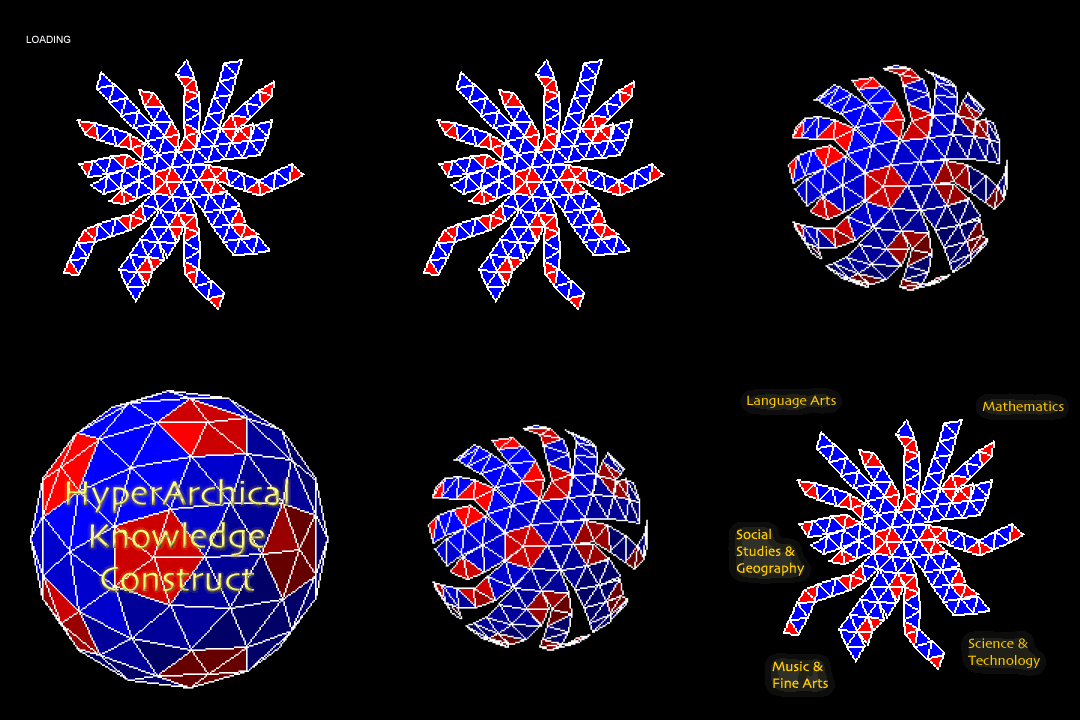
Knowledge domains are hierarchically organized information one has adopted that create learning or living strategies. These Heterachies, or stategy strands, that are made up of these knowledge domains. Heterachies are comprised of hierarchically organized knowledge. While having a common core or point of origination, i.e. a school, these heterarchies neither necessarily nor meaningfully relate to one another unless one creates a learning environment that demands a sort of cross-pollination, such as is found using the TW3K technology.



School Without Walls' robotics class will be designed to enhance the opportunities to create these structures and enhance what R. Buckminster Fuller dubbed 'synergy'.
"Robots, Inc/Extreme 'Bots, Inc." will be an independent class with 12 to 15 students (more can be added). Using the TW3K learning environment, a variety of traditional subjects, even those being taken by students in the course of their studies, will have modules designed and matched with "corporate departments" as a way to optimize the opportunities for geodesic learning and bring new meanings to their experience.
Sometimes I think we're alone.
Sometimes I think we're not.
In either case, the thought is staggering.
R. Buckminster Fuller
Knowledge domains are hierarchically organized information one has adopted that create learning or living strategies. These Heterachies, or stategy strands, that are made up of these knowledge domains. Heterachies are comprised of hierarchically organized knowledge. While having a common core or point of origination, i.e. a school, these heterarchies neither necessarily nor meaningfully relate to one another unless one creates a learning environment that demands a sort of cross-pollination, such as is found using the TW3K technology.

When a Heterarchy reaches it's limit it is clear how nearly impossible it is for one strategy strand to connect with another, even though the contents of one strategy strand, the collected hierarchical knowledge that a heterarchy represents, might be useful in or with another. However, this not need be the case. A rather magical process can kick in called Self-assembly. [This definition has greatly expanded since the term was first used and linked in the original online paper, 2001] This results in the immediate construction of a HyperArchy.

This same Self Assembly process continues with in the HyperArchy and works in a way reminiscent of wormholes (from the Cosmology of Space, Time and Learning, 2001.)

However, this HyperArchy is not the only one we have. We are always constructing these geodesic spheres of knowledge.

Like all good dynamic processes and systems, the same magical linking occurs among HyperArchies ...

However, this synergy among HyperArchies does not stop. In fact, the hypothesis of this theory of learning, the Geometry of Learning, posits that the Nth iteration of this process (death or the inability to learn and retain information) there is a huge, almost infinitly interconnected HyperArchy and the Architecture is

the Soccer Ball of Knowledge
Conclusion
School Without Walls' robotics class will be designed to enhance the opportunities to create these structures and enhance what R. Buckminster Fuller dubbed 'synergy'.
"Robots, Inc/Extreme 'Bots, Inc." will be an independent class with 12 to 15 students (more can be added). Using the TW3K learning environment, a variety of traditional subjects, even those being taken by students in the course of their studies, will have modules designed and matched with "corporate departments" as a way to optimize the opportunities for geodesic learning and bring new meanings to their experience.
As a full-time class wherein all subjects are taught, TW3K would begin with a group of 9, 12 or 15 students. All students would be in the same grade, taking the same classes with the same teachers at the same time. This "class" would work within the TW3K context for all its work and learning for at least a semester if not the entire year. Assessments of its success as a learning environment would be on-going and result in an end-of project evaluation. And, this being New York where high stake testing reigns supreme, the program would show significantly higher test scores.
PS This entire learning theory owes its construction to R. Buckminster Fuller.

Watch as "Bucky" reveals to you all he knows - in just 41 minutes!
Nick Clark

Watch as "Bucky" reveals to you all he knows - in just 41 minutes!
Nick Clark
Material Copyright 1998 - 2009
Sometimes I think we're alone.
Sometimes I think we're not.
In either case, the thought is staggering.
R. Buckminster Fuller


 Posts
Posts


No comments:
Post a Comment